Complex Adaptive Systems and Computational Biology
Research Interests
Almost all interesting processes in nature are highly cross linked. In many systems, however, we can distinguish a set of fundamental building blocks, which interact nonlinearly to form compound structures or functions with an identity that requires more explanatory devices than those used to explain the building blocks. This process of emergence of the need for new, complementary, modes of description is known as hierarchical self-organization, and systems that observe this characteristic are defined as complex. Examples of these systems are: gene networks that direct developmental processes; immune networks that preserve the identity of organisms; social insect colonies; neural, physiological, and technological networks that produce intelligence; ecological networks; social networks comprised of transportation, utilities, and telecommunication systems, as well as economies. We are particularly interested in the informational properties of natural and artificial systems that enable them to adapt and evolve. This means both producing computational models of biological systems to understand the evolutionary role of information, as well as abstracting principles from biology to produce adaptive information technology. Our current research projects (see details below) are on complex dynamics in biological networks gene regulation, cell signalling, and metabolic networks, text and literature mining (in proteomics, protein-protein interaction and pharmokinetics), computational models of RNA Editing, artificial immune systems, genomic multivariate analysis, evolutionary systems, artificial life, cognitive science, and biosemiotics.
Computational Biology Collaboratorium
![]()
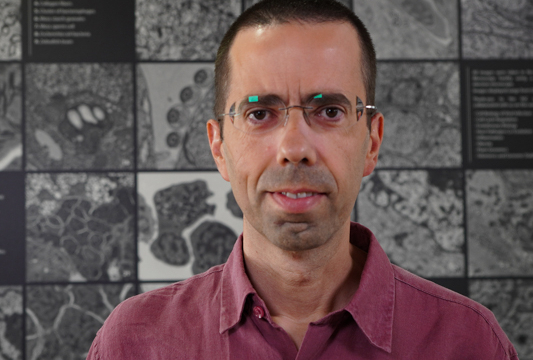
Luís Rocha
Ph.D. in Systems Science
State University of new York, New York
| Principal Investigator | |
|---|---|
| Phone | 21 446 4660 |
| Extension | 660 |
| Location (Wing) | Amerigo Vespucci (E3) - Room 3E |
| Website | |
Group Members
Research Project
Biomedical Literature Mining
Literature-based automatic discovery, classification and annotation of protein-protein and gene-disease interactions, pharmokinetic data, protein sequence family and structure prediction, functional annotation of trancription data, enzyme annotation publications, and so on. Click here for more detailed information.
Funding
FLAD Computational Biology Collaboratorium
FCT Grant
Collaborators
Universidade do Minho (Portugal)
Anália Lourenço
Queen's University (Canada)
Hagit Shatkay
Research Project
Collective Dynamics in Complex Biochemical Networks
Modeling of biochemical signaling, regulation, modularity, robutsness and emergent computation in the dynamics of complex networks. Our methodology identifies canalizing control patterns in discrete automata models of biochemical networks. Currently working with models of genetic regulation in yeast , flowering of Arabidopsis thaliana; body segmentation in Drosophila, intracellular signal transduction in fibroblasts, biochemical pathways in granular leukemic lymphocytes, an integrated genome-scale transcriptional and metabolic network for E-Coli, and others. Click here for more detailed information.
Funding
FLAD Computational Biology Collaboratorium
FCT Grant
Collaborators
University of Barcelona (Spain)
Marta Cascante
University of California (Davis)
Jim Crutchfield
Portland State University
Melanie Mitchel
Michigan University (USA)
Santiago Schnell
University of Budapest (Hungary)
George Kampis
Universidade do Minho (Portugal)
Miguel Rocha
Instituto Gulbenkian de Ciência (Portugal)
Claudine Chaouiya
Instituto Gulbenkian de Ciência (Portugal)
Filipa Alves
Research Project
Computational Models of RNA Editing
Computational models to study the evolutionary implications of genotype editing in the living organization. Our agent-based model of genotype editing contains agents in which coding and non-coding genetic components are allowed to coevolve. Our goal is twofold: (1) to study the role of RNA Editing regulation in the evolutionary process, and (2) to investigate the conditions under which genotype edition improves the optimization performance of evolutionary algorithms. Click here for more detailed information.
Funding
FLAD Computational Biology Collaboratorium
Collaborators
Lehigh University (USA)
Stefan Mass
Instituto Gulbenkian de Ciência (Portugal)
Alekos Athanasiadis
Research Project
Artificial Models of T-Cell Cross-regulation
We use Jorge Carneiro's Model of Cross-regulation in T-Cell dynamics to produce bio-inspired algorithms for binary classification. We are interested at the capability of this model to develop collective dynamics capable of binary classification. The goal is to gain further insights about T-Cell Cross-regulation in the vertebrate Immune System, and produce useful bio-inspired algorithms for text mining and spam detection. Click here for more detailed information.
Funding
FLAD Computational Biology Collaboratorium
FCT Grant
Collaborators
Instituto Gulbenkian de Ciência (Portugal)
Jorge Carneiro
Instituto Superior Técnico
Pedro Lima
Instituto Superior Técnico
Porfirio Silva
Research Project
Stochastic Models of Topology Constraints on Complex Networks
Study of transitive properties of complex networks modeled as weighted graphs. In particular, we are studying how distance measures derived from such graphs lead to distinct transitive closures. We are identifying the impact of alternative distance measures on scale free and small-World behavior. We are also developing stochastic models of vertex aging in networks, to better predict network growth. We apply the methodology to various real problems: keyword co-occurrence networks for information retrieval, networks of neuronal activity, wikipedia records, etc. Click here for more detailed information.
Funding
Uninova collaboration
Collaborators
Instituto Superior de Economia e Gestão
Nuno Crato
Publications
selected publications. Updated June (2010). Full List available here
A. Abi-Haidar and L.M. Rocha (2010). Collective Classification of Biomedical Articles using T-Cell Cross-regulation
In: Artificial Life XII: Twelfth International Conference on the Simulation and Synthesis of Living Systems. S. Rasmussen et al (Eds.). MIT Press
In press
A. Kolchinsky, A. Abi-Haidar, J. Kaur, A.A. Hamed and L.M. Rocha (2010). Classification of protein-protein interaction full-text documents using text and citation network features IEEE/ACM Transactions On Computational Biology And Bioinformatics In Press
Z. Wang, S. Kim, S.K. Quinney, Y. Guo, S.D. Hall, L.M. Rocha, and L. Li (2009). Literature mining on pharmacokinetics numerical data: A feasibility study Journal of Biomedical Informatics 42(4) :726-735
T. Simas and L.M. Rocha (2008). Stochastic model for scale-free networks with cutoffs Physical Review E 78(6) :066116
A. Abi-Haidar, J. Kaur, A. Maguitman, P. Radivojac, A. Retchsteiner, K. Verspoor, Z. Wang, and L.M. Rocha (2008). Uncovering protein interaction in abstracts and text using a novel linear model and word proximity networks Genome Biology 9(Suppl 2) :S11
M. Marques-Pita, M. Mitchell, and L.M. Rocha (2008). The Role of Conceptual Structure in Learning Cellular Automata to Perform Collective Computation
In: Unconventional Computation: 7th International Conference (UC 2008). , : Lecture Notes in Computer Science. Springer-Verlag
5204 :146-163
C. Huang, J. Kaur, A. Maguitman, L.M. Rocha (2007). Agent-Based Model of Genotype Editing Evolutionary Computation 15(3) :253-89
Maguitman, A. G., Rechtsteiner, A., Verspoor, K., Strauss, C.E., Rocha, L.M. (2006). Large-Scale Testing Of Bibliome Informatics Using Pfam Protein Families In Pacific Symposium on Biocomputing 11 :76-87
Rocha, Luis M. and W. Hordijk (2005). Material Representations: From the Genetic Code to the Evolution of Cellular Automata Artificial Life 11(1-2) :189 - 214
Challacombe, J,, A. Rechtsteiner, G. Gottardo, L.M. Rocha, E.P. Brown, T. Shenk, M. Altherr, T. Brettin (2004). Evaluation of the host transcriptional response to human cytomegalovirus infection Physiol. Genomics. 10.1152 physiolgenomics :00155.2003
Wall, Michael E., Andreas Rechtesteiner, and Luis M. Rocha (2003). Singular Value Decomposition and Principal Component Analysis .
In: A Practical Approach to Microarray Data Analysis. D. P. Berrar, W. Dubitzky, and M. Granzow (Eds.) Kluwer Academic Publishers
:91-109
Rocha, Luis M. (2002). Semi-metric Behavior in Document Networks and its Application to Recommendation Systems
In: Soft Computing Agents: A New Perspective for Dynamic Information Systems. V. Loia (Ed.) International Series Frontiers in Artificial Intelligence and Applicat
IOS Press :137-163
Rocha, Luis M. (2001). Evolution with material symbol systems Biosystems 60 :95-121
Rocha, Luis M. (1996). Eigenbehavior and symbols Systems Research 13(3) :371-384